Stay healthy
- Recommendations for preventive measures
- Prevention tips and plain-language information
18 digital screenings over 12 months, for mental and physical health. Employees screen themselves, a contracted physician sees findings that need attention, and you see only de-identified numbers.
Most of the productivity lost to poor health happens while people are at work. At the same time, health benefits keep getting more expensive and fewer than one in three employees feel engaged.

of productive time are lost per U.S. worker each year to poor health. 54 of those days are lost while working unwell.
Vitality, 2026 (self-reported)1of scheduled hours of full-time employees are lost to their own illness or injury. That is about three workdays per year.
BLS, 20252was the average annual premium for employer-sponsored family health coverage in 2025, up 6% from the year before.
KFF Employer Health Benefits Survey 20253Every participant starts with a personal risk profile. The app then guides them through twelve health topics, each with a risk check, ongoing support, and results with a report.
1risk profile to start18health topics7lifestyle factors alongside
Alongside the twelve stages, seven lifestyle topics run all year. Employees pick matching 7-day programs themselves and start them right in the app: free for them and no extra work for HR.

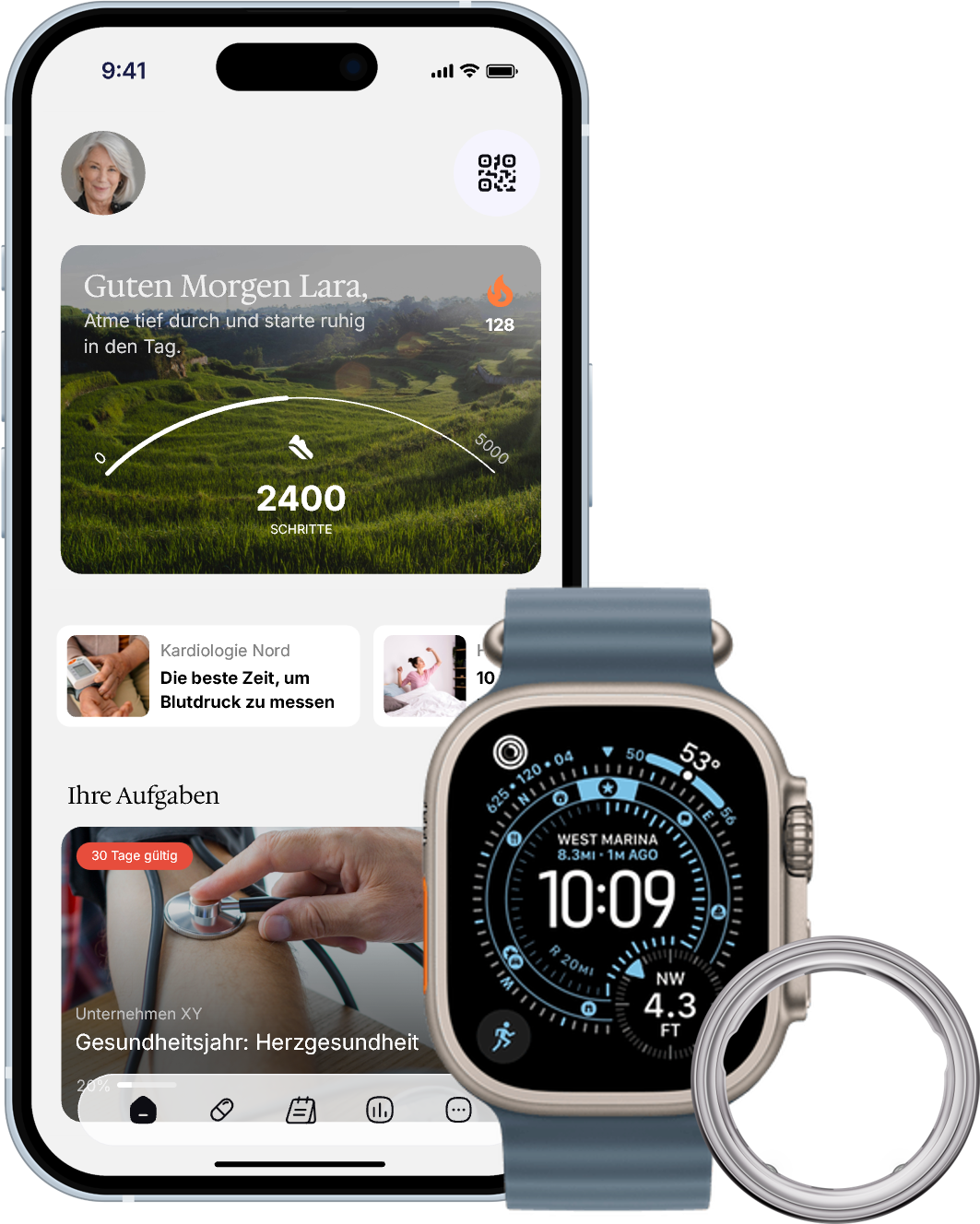
Employees use the Health Year in the myoncare app for iOS and Android or directly in the browser. Content, questionnaires and reminders arrive when they are relevant.
Employees screen themselves, a contracted physician sees findings that need attention, and your company sees only de-identified numbers. You only see de-identified, aggregated data.
screen themselves and see their own results.
sees findings that need attention and invites people to follow-up care. Only clinically relevant cases are escalated.
receives an annual report with aggregated metrics and recommendations.
Reports cover groups of 10 or more people only. Individual results are never visible to the employer.
are visible only to the employee and the contracted physician. Physician–patient confidentiality applies.
sees only de-identified, aggregated reports, never individual data. Reports require a minimum group size of 10 people.
Participation is voluntary and requires each employee's consent.
 For employees
 For employers
Most employers already offer a health plan and an employee assistance program. The Health Year adds what is usually missing: a guided, year-round prevention program that reaches every employee.
You contract with myoncare and offer the Health Year to all employees, whether or not they are enrolled in your health plan.
Your insurer or plan administrator adds the Health Year to the plan's wellness offering. Health plans can also offer it to their employer clients.
Studies of workplace wellness programs show mixed results. Effects depend heavily on who takes part and how targeted the program is.
A meta-analysis of workplace wellness programs found absenteeism costs fall by about $2.73 and medical costs by about $3.27 for every dollar spent.
Baicker, Cutler & Song, Health Affairs 20105A trial with about 33,000 employees found healthier self-reported behavior after 18 months, but no difference in absenteeism, medical spending or clinical measures.
Song & Baicker, JAMA 20196Working while unwell accounts for 54 of the 63 productive days lost per U.S. worker each year. This effect is not included in the calculator.
Vitality, 2026 (self-reported)1Why this matters for program design: the JAMA editorial on the trial recommended more targeted approaches instead of broad programs6. The Health Year is built around that idea: a personal risk profile, topics matched to each person's risk and clear next steps when a finding needs attention.
Five inputs give you a first estimate. The model is deliberately conservative: it only counts avoided sick days, with a ramp-up in year one.
Pricing: You pay only for employees who take part. Cash or gift-card rewards for participating are taxable wages for employees, so most employers keep incentives modest or non-cash.
Illustrative model, not a guarantee, and not tax or legal advice.
| Input | Assumption | Basis |
|---|---|---|
| Sick days | Default 3 workdays per employee per year | BLS: 1.1% of scheduled hours of full-time employees lost to own illness or injury in 2025, about 2.9 days2. Self-reported surveys show more (9.5 days)1 |
| Salary | Default $65,000 | Median weekly earnings of full-time employees, Q2 2026: $1,2587 |
| Cost per sick day | Salary × 1.43 ÷ 260 workdays | Benefits add 43% on top of wages (total compensation $46.89 per hour vs. wages $32.82, private industry, June 2026)8 |
| Effect for participants | Conservative −10%, realistic −15%, optimistic −20% of sick days | Below the meta-analysis estimate5. Discounted because a large randomized trial found no effect on absenteeism6 |
| Ramp-up | Half of the effect in year one | Topics are added month by month; own assumption |
| Self-selection | Participants have 20% fewer sick days than average | Healthier employees are more likely to take part; own assumption |
| Cost | $5 per participating employee per month; billed only for participants | Indicative myoncare price; quote on request |
Formula: Avoided days = participants × sick days × 0.8 × effect × ramp-up factor. Return per dollar = avoided days × cost per day ÷ Health Year cost. Break-even = cost per participant ÷ cost per day.
Deliberately not included: presenteeism, which accounts for most lost productive time1, turnover, temporary replacement costs and any effect on health plan claims. Randomized trials have not shown short-term savings on medical spending6, so the model leaves them out.
You contract with myoncare directly and offer the Health Year to your whole workforce. A contracted physician reviews findings that need attention. You receive the annual report.
Your insurer or plan administrator includes the Health Year in the plan's wellness offering. Health plans can offer it to all their employer clients.
The route you choose affects which rules apply, including HIPAA and the rules for wellness incentives. We review the setup with you and your counsel. Not legal or tax advice.
Several federal laws and a growing number of state laws apply to workplace wellness programs. These are the rules HR, benefits and legal teams usually ask about.
Participation is voluntary and requires consent. Employers receive de-identified reports for groups of 10 or more only.
myoncare program designWellness programs that ask health questions must be voluntary. The EEOC removed its incentive limits in 2019 and withdrew a new proposal in 2021, so the permitted size of incentives is currently not defined.
EPIC; K&L Gates1112Employers with 15 or more employees may collect family medical history only in voluntary programs and may not offer incentives in exchange for it.
EEOC13Offered through a group health plan, the data is protected health information under HIPAA. Offered directly by the employer, HIPAA does not apply, but other federal and state laws may.
HHS9Inside a group health plan, rewards for meeting a health standard may not exceed 30% of the cost of employee-only coverage, or 50% for tobacco programs. Participation-only programs have no such limit.
Withum10Cash, gift cards and gym memberships given as wellness rewards are taxable wages for employees, even in small amounts.
SHRM on IRS CCA 20162203114This overview is not legal or tax advice. State laws on health data and paid sick leave vary. We review the setup with you and your counsel.
We discuss your workforce, locations, how you want to offer the program and the role of the contracted physician.
By email, intranet, posters or QR code. We provide the communication materials.
Employees screen themselves. The contracted physician sees findings that need attention and invites people to follow-up care.
Aggregated metrics and recommendations for next year, ready for your benefits review.
No. Individual results are visible only to the employee and the contracted physician, and physician–patient confidentiality applies. Your company receives de-identified, aggregated reports only, and only for groups of 10 or more people.
Yes. Participation is voluntary and requires each employee's consent.
A licensed physician under contract for your program. The physician reviews findings that need attention and invites employees to follow-up care. Details are agreed in the first call.
It depends on how you offer the program. Offered through your group health plan, HIPAA applies. Offered directly as an employer benefit, HIPAA generally does not apply, but other federal and state laws may. Either way, the employer never sees individual results.
Yes, within limits. Incentives may not be tied to family medical history. Cash and gift-card rewards are taxable for employees. Inside a group health plan, rewards for meeting health standards are capped. We recommend reviewing incentives with your counsel.
No. Employees sign up with a QR code or link and use the app or the browser. myoncare operates the platform.
Yes. The Health Year runs on personal smartphones and in the browser. Invitations can also go out on posters or flyers with a QR code.
Pricing is per participating employee per month, so you pay only for people who take part. You can buy it directly or through your health plan. We prepare a quote in the first call.
The Health Year runs on the myoncare platform, developed by ONCARE GmbH and offered in the U.S. by myoncare, Inc.
The standards and certifications listed refer to the quality management system (QMS) and information security management system (ISMS) of ONCARE GmbH, which is responsible for developing the myoncare health platform. More on quality & security

In 30 minutes we show you the app, the report and the topic plan, and run the savings estimate with your own numbers.